
A bald-faced hornet nest is a grey, papery ball with a single round entrance hole near the bottom. By late August it holds several hundred hornets that will defend it aggressively from several feet away. It is not a do-it-yourself job. Last week we took four of them off a single deck in West Central Wisconsin. Here is exactly what that looked like, and how to tell whether the nest on your property needs to come down now.
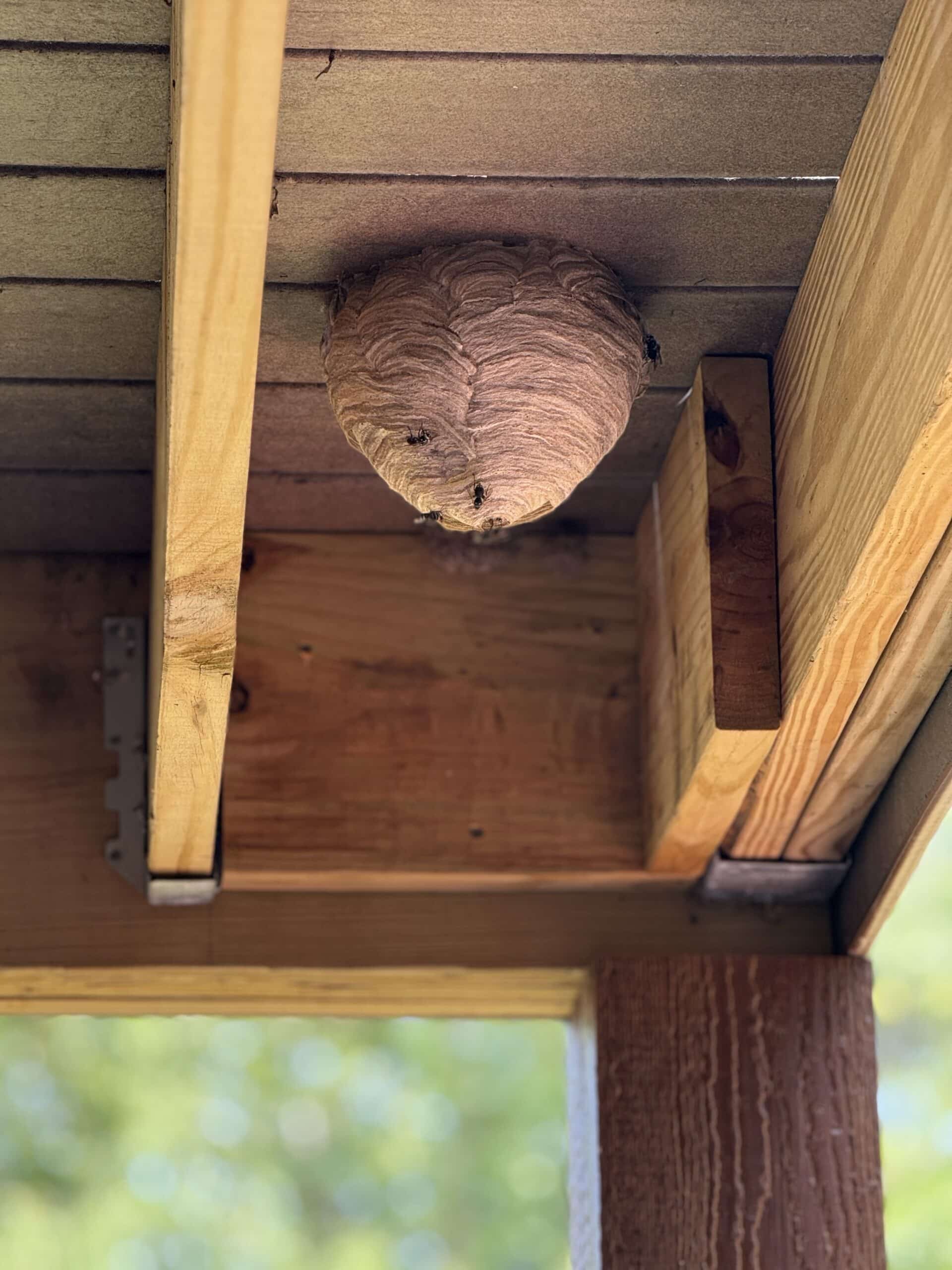
What does a bald-faced hornet nest look like?
A mature bald-faced hornet nest is a grey-to-tan enclosed ball or teardrop, football-sized to basketball-sized, with visible horizontal ridges where the layers of paper overlap. There is one entrance hole, usually near the bottom, and it is often the only opening you will find. That single-entrance, fully-enclosed shape is what separates it from the open, umbrella-shaped comb of a paper wasp, which has exposed hexagonal cells you can see from below.
The material is actual paper, chewed wood fiber mixed with saliva. That is why an abandoned nest disintegrates over a Wisconsin winter, and why spraying one from below tends to blow a hole in the envelope without ever reaching the colony inside.
One clarification worth making, because it changes how the insect behaves: despite the name, a bald-faced hornet is not a true hornet. It is a yellowjacket, Dolichovespula maculata, and it is far more defensive of its nest than the ground-nesting yellowjackets most people picture.
How do you tell a yellowjacket nest from a hornet nest?
By the shape of the nest and where it is, and it is the first thing our techs check on arrival, because it changes the entire treatment. Bald-faced hornets build the enclosed ball described above, hanging in the open where you can see the whole thing. Yellowjackets build comb, and they almost always put it somewhere you cannot see it: in the ground, behind siding, inside a soffit or wall void. What you notice is not a nest but a hole with steady traffic going in and out.
Homeowners get this wrong constantly, and that is not a criticism. From the ground, at a distance, with something stinging at you, it is a hard call. On a recent job the customer described a wasp nest over the phone; when the tech arrived it was an active yellowjacket colony working out of the gap behind a dryer vent on the back of the house. Same “wasp problem” on the schedule, completely different job on site. That is why we identify before we treat instead of the other way round.
Why do hornets build nests under decks and soffits?
A queen looking for a nest site wants overhead cover, a solid anchor point, and low traffic in early spring when the nest is the size of a golf ball. Deck ceilings, soffit gaps, eave returns, and the underside of pergolas check every box. By the time the nest is big enough for a homeowner to notice in July, the colony has had three or four months of undisturbed growth.
The problem is that those same spots are where people are. A nest in a tree at the back of the lot is a curiosity. A nest six feet over a patio table is a liability.
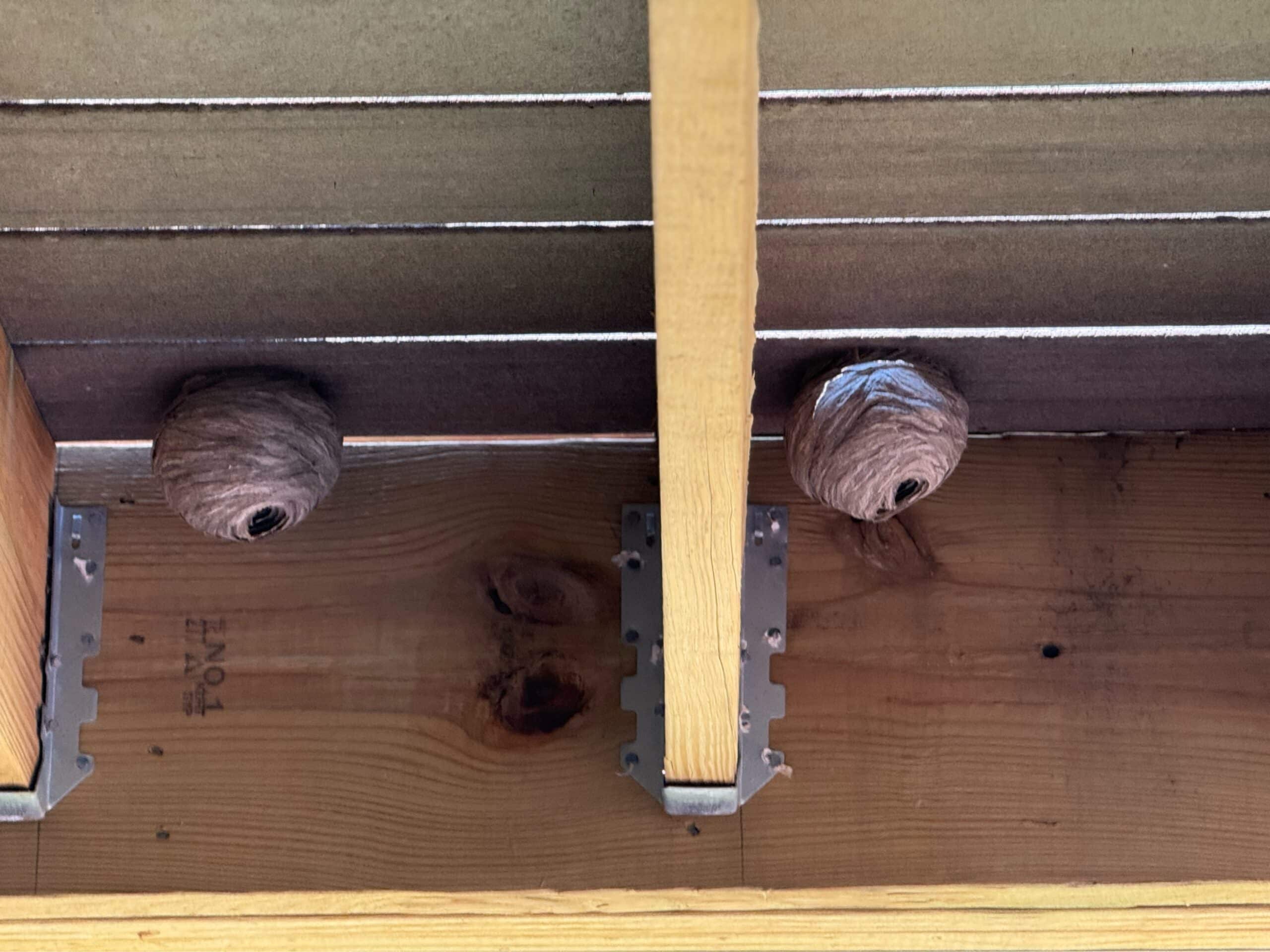
Can there be more than one nest on the same house?
Yes, and it is more common than people expect. On this job the customer called about a single nest and we found four across the structure, including the two above, built side by side in the same soffit-to-rafter gap, each with its own entrance.
When one spot on a building is sheltered enough to attract a queen, the spots next to it usually are too. This is the practical reason a stinging insect call should include a full perimeter inspection rather than treatment of the one nest that got spotted from the driveway. Treating one of four is not a solved problem.
What is inside a hornet nest?
Underneath the paper envelope are horizontal tiers of hexagonal brood comb, stacked like floors in a building and connected by a central stalk. The queen lays in those cells, workers feed the larvae, and the whole structure expands outward all summer as the population grows. The hornets chew away the inner layers of the envelope and add new ones to the outside as they need room.
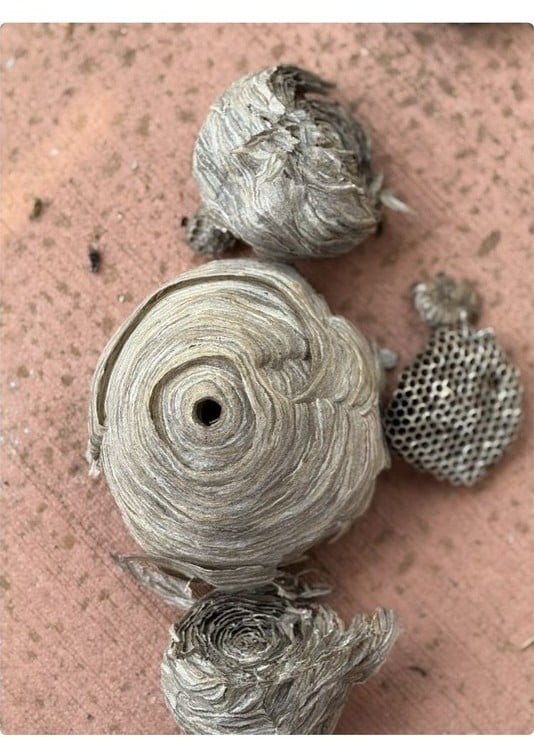
The nest at the right of that photo is cut open deliberately. It is the clearest way to show homeowners why a hardware-store aerosol so often fails: the colony does not live on the surface you are spraying. It lives several paper layers in, on comb the spray never contacts.
Do you remove the nest, or just treat it?
It depends entirely on whether the nest is exposed. If we can see it and reach it, whether that is under a deck, in a soffit return, or off an eave, we treat it and then take it down, which is how the four nests in the photo above ended up on the patio. If the colony is in the ground or behind siding, we treat it and leave it in place.
That second answer surprises people, so it is worth explaining. Opening a wall or digging out a void to retrieve comb does more damage than the nest is doing, and an eliminated colony sealed in a cavity is inert. It is not going to reactivate. For those, the job is the treatment and then closing the entry point, not extraction. Any company that promises to pull a nest out of your siding is selling you demolition.
When are hornet nests at their biggest?
Bald-faced hornet colonies are annual. A single overwintered queen starts the nest in spring, and the population climbs all season to peak in late summer, commonly several hundred workers by August or September in Wisconsin, in a nest that was fist-sized in June. Defensive behavior scales with that population.
So the nest you decided to live with in early July is a materially different problem in mid-August. This is the stretch when we take the most stinging insect calls across Eau Claire, Chippewa Falls, and Menomonie, and it is when a nest near a door, deck, or play area stops being something to monitor.
Is it safe to remove a hornet nest yourself?
No. The honest reason is equipment, not nerve. Our techs do not get stung on these jobs. Not because they are braver than you are, but because they arrive in a bee suit and work the nest deliberately, in a planned order, with the right material for where it sits. A homeowner on a stepladder in a t-shirt is attempting the same job without the one thing that makes it routine.
The insects supply the rest of the problem. Bald-faced hornets defend a radius around the nest and respond in numbers to vibration and to a threat at the entrance. Unlike a honeybee, each one can sting repeatedly. Add a ladder and you have the two ingredients behind most serious stinging-insect injuries: a defensive colony and an unstable place to stand.
The specific failure modes we get called out to fix:
- Spraying from directly below. Puts you under the entrance, in the drop zone, with hornets coming out at your face.
- Knocking the nest down. Relocates a live colony to the ground you are standing on. It does not end it.
- Sealing the opening on a void nest. Hornets in a wall or soffit cavity will chew a new exit, sometimes to the interior side of the wall.
- Treating at midday. Peak forager activity outside the nest, which means peak defenders available to respond.
If anyone in the household has a known stinging insect allergy, treat the nest as an emergency and keep the area clear until it is handled.
Will the hornets come back next year?
Not to the same nest. Bald-faced hornet nests are abandoned in fall, the colony dies off with the first hard frosts, and the old nest is never reoccupied. If you find a grey paper ball in a bare tree in January, it is empty.
The location, though, is a different story. A soffit gap or deck ceiling that suited a queen this spring will suit one next spring. That is why removal alone is only half the work: the other half is closing the gaps that made the spot attractive and keeping a treated perimeter through the nesting season.

What we do on a stinging insect call
- Identify the species and the nest type. Enclosed ball hanging in the open, or comb hidden in a void? Bald-faced hornet, aerial yellowjacket, ground-nesting yellowjacket, and paper wasp all get handled differently. What the customer describes on the phone is a starting point, not a diagnosis.
- Inspect the full structure. Soffits, eaves, deck framing, pergolas, sheds, grade-level voids, dryer and utility penetrations. We assume there is more than one nest until we have confirmed there is not.
- Match the method to the location. Dust, liquid, or aerosol, depending on what the tech finds. For a colony in the ground or behind siding it is insecticide dust placed directly into the opening roughly 95% of the time. The workers carry it through the nest far more thoroughly than any spray reaches on its own.
- Remove the nest if it is exposed. Left hanging, it stains siding, draws secondary pests as it breaks down, and makes it impossible to tell later whether new activity is a fresh nest. Colonies in voids and in the ground stay where they are.
- Close the entry points and set a preventive perimeter so the same soffit gap or vent does not host the same problem next June.
Have a nest you are watching?
Stinging insect work is time-sensitive and we schedule it that way. More than one customer has come to us after another company could not get out quickly enough. When the colony is beside a door, a deck, or a dryer vent, “sometime next week” is not an answer.
1st Choice Pest Solutions handles stinging insect nest removal across West Central Wisconsin and Eastern Minnesota: Eau Claire, Chippewa Falls, Menomonie, River Falls, Hudson, Rice Lake, and the surrounding communities. Do not get on a ladder for this one.


